

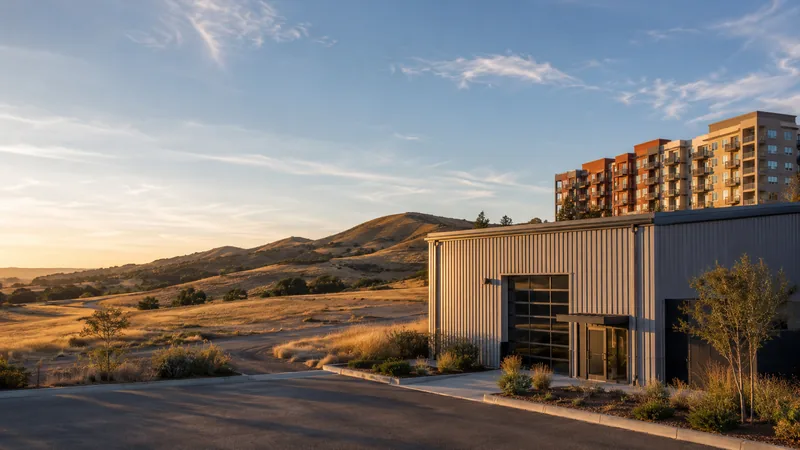
What a no-doc investment property loan is
Banks and credit unions evaluate equity loans the way they evaluate every other loan: tax returns, employment letters, debt-to-income ratios, sometimes a DSCR calculation if it’s a rental. That works fine if your file is clean. It does not work if you own raw land, if your commercial building sits vacant during repositioning, if your company occupies its own warehouse and you can’t show third-party rent, or if you’re an investor with strong equity but unprovable income.
Our no-doc investment property loan looks at one thing: the equity in the property. Up to $500,000 first-lien at 50% loan-to-value. You supply photos of the property. We fund the wire in about two weeks. There’s no income calculation, no rental projection, no debt-service coverage ratio, no appraisal. The qualification test is two facts: do you have at least 690 FICO, and does the math pencil at 50% LTV? Everything else is paperwork that confirms what you already told us.
This is business-purpose financing. The property has to be held for investment, used by your own business, or held as raw land or commercial real estate. It cannot be your primary residence. Single-family rentals, multi-unit residential, office, retail, industrial, mixed-use, and bare land all qualify. Hospitality use is the one exclusion: hotels, motels, B&Bs, and short-term-rental businesses are out.
Who this loan is for
Five borrower profiles use this loan more than any other.
Investors holding bare land. California land is expensive and rarely income-producing. Conventional land lenders want 35% to 50% down on a purchase and they don’t really do cash-out at all. Hard money will fund land but at 9% to 13% with a balloon in 12 to 24 months. This loan funds bare land at Prime + 2.5% for five years amortized over 25, against equity you already have.
Business owners whose company occupies its own commercial property. You own the warehouse, your LLC operates from it. There’s no third-party tenant, so there’s no rental income to plug into a DSCR ratio. Owner-occupied conventional doesn’t fit because you’re not living there. This loan ignores rent entirely.
Self-employed investors with strong equity but unprovable income. Your W-2 says zero, your tax returns show a loss after write-offs, but you have real cash flow and real property. The income calculation is the problem. We skip it.
Investors with vacant or repositioning commercial property. The building doesn’t generate rent right now. Maybe the last tenant left, maybe you’re mid-renovation, maybe you bought it as a value-add play. DSCR lenders need market-rent projections you can’t deliver yet. We don’t ask.
ITIN holders and non-profits holding investment real estate. You have the equity and the entity, you just don’t fit the borrower categories most lenders recognize. We lend to US citizens, lawful permanent residents, ITIN holders, and non-profits. LLC, corporation, or trust entities are all eligible borrowers.
The two-week funding timeline
The published timeline is two weeks from complete file to wire. Here’s what each phase looks like.
Day 0. You submit the four-field short application. Name, email, property address, current debt on the property. That’s it. We review and confirm the file is workable based on the basics.
Day 1 to 2. Rodney calls you. We send the full document request list. The list is short: photo set of the property, entity formation documents if you’re borrowing through an LLC or corporation, mortgage statements for any existing liens, ID, and a one-page borrower information sheet.
Day 3 to 7. You gather and send the documents. We open title and confirm lien position. The borrower-supplied photo set substitutes for the appraisal that other lenders require, which removes the single biggest scheduling bottleneck in this type of loan.
Day 8 to 12. Underwriting and title work happen in parallel. The underwriter confirms FICO, confirms the property meets the eligible-type test, confirms LTV against the value supported by your photos, and confirms borrower eligibility. Title clears liens, judgments, and ownership.
Day 13 to 14. Docs go out for signing. Funds wire on signing day.
What slows the timeline
- Incomplete or low-quality property photos that don’t show the exterior, interior, and any outbuildings clearly
- Missing or out-of-date entity formation documents
- Mortgage statements that don’t show current payoff figures
- Title clouds: unrecorded liens, mechanic’s lien claims, ownership disputes, probate items
- Slow lien-payoff statements from existing servicers
- Escrow scheduling conflicts during signing
A clean file that arrives complete on day one closes inside the two-week window. A file that drips in over a week pushes the close out by however long the drip takes.
Property types we lend on
The eligible property list is broad on purpose. Five categories cover essentially everything except hospitality.
Residential investment. Single-family rentals, 2-4 unit residential properties, and similar non-owner-occupied homes. The property has to be held as an investment, not lived in by the borrower as a primary residence.
Multifamily, 5+ units. Apartment buildings and small to mid-sized multifamily properties qualify on the same equity-only terms as everything else. No DSCR ratio, no rent roll required.
Commercial. Office, retail, industrial, mixed-use. Owner-using situations are fine, meaning a building owned by an entity and occupied by the borrower’s own operating business. The structure makes the loan business-purpose either way.
Land. Raw, unimproved, lots, entitled parcels. Bare land prices at Prime + 2.5% instead of Prime + 2% to reflect the slightly different risk profile, but the qualification test is identical. This is the segment where the loan does the most that competitors cannot match.
Property condition flexibility. Habitable and non-habitable both work. A boarded-up retail space, a partially demolished mid-renovation home held in an LLC, a vacant office building between tenants. They all qualify if the equity math passes. The condition feeds the photo set, not a separate inspection.
The one exclusion: hospitality use
Properties currently operating as hotels, motels, B&Bs, or active short-term-rental businesses (Airbnb, VRBO, and similar) are not eligible. This is a current-use restriction. A former motel converted to long-term apartments is fine. An active motel with a front desk and a current operating license is not.
Why no DSCR, no appraisal, and no income docs matters
Three pieces of friction that other equity lenders require, we don’t. Removing them changes who can use this loan and how fast it closes.
No DSCR ratio
Debt-service coverage ratio is the rental-income math a lot of lenders use to qualify investment property loans. The property has to generate enough monthly rent to cover the proposed loan payment, with some margin. DSCR works fine for stabilized rentals with current leases in place. It does not work for property that doesn’t produce rent.
Raw land doesn’t produce rent. Vacant commercial property doesn’t produce rent. A warehouse occupied by the borrower’s own LLC doesn’t produce arms-length rent. A retail building between tenants is rent-free until the next lease is signed.
DSCR loans handle some of these cases with market-rent surveys, where an appraiser estimates what rent the property could earn. That works for stabilized property types in established rental markets. It falls apart for land, owner-using buildings, and properties in unusual configurations. We avoid the question entirely. There is no rental analysis at any stage.
No appraisal, photos only
The valuation input is the photo set you provide. The underwriter reviews your photos, confirms the property type, and works against the value you represent for the loan amount. There is no third-party appraisal, no broker price opinion, no drive-by inspection, no AVM run, no desktop appraiser pulling MLS comps.
Three concrete effects:
- No appraisal scheduling. The single biggest cause of a 30-day close on competitor products is the appraisal calendar.
- No appraisal fee. A commercial or land appraisal in California runs anywhere from $700 to $4,000 depending on property type and complexity. You don’t pay it.
- No third party entering the property. For an owner-using business, a vacant building under repositioning, or a property the borrower would rather not have walked, this matters more than the fee.
No income documentation at all
Not “no W-2 but show me 12 months of bank statements.” Not “stated income with bank-statement verification.” There is no income calculation of any kind. No tax returns, no profit-and-loss statements, no bank statements for income, no employment letter, no asset-verification statement for liquid reserves.
The qualification test is FICO, lien position, LTV, eligible property, and eligible borrower. Income does not appear in that list because we don’t look at it.
How qualification works
Five conditions. That is the test.
- 690 minimum FICO. A single credit score under that number disqualifies the file. The 690 floor is firm and applies regardless of compensating factors.
- 50% maximum loan-to-value. Pulled against the value your photos and the file support. If the property is worth $1,000,000, the maximum loan is $500,000. The minimum loan amount is $50,000.
- Eligible property type. Residential investment, multifamily 5+, commercial (office, retail, industrial, mixed-use), or land. Hospitality use disqualifies.
- Eligible borrower or entity. US citizens, lawful permanent residents, ITIN holders, and non-profits qualify as natural-person borrowers. Loans can also fund through an LLC, corporation, or trust where the entity is the named borrower.
- Not your primary residence. This is business-purpose financing. The property has to be held for investment, used by your own business, or held as raw land or commercial real estate. Owner-occupied residential primary homes are out.
There is no minimum income, no debt-to-income ratio, no rent-to-payment ratio, no reserve requirement, no asset-verification statement, no employment verification, no length-of-business-ownership rule, no seasoning requirement on the property, and no minimum borrower experience. If the five conditions above pass, the file works.
Rates and terms
Pricing is indexed to the Wall Street Journal Prime Rate, which moves with Federal Reserve decisions and is published daily.
Residential investment, commercial, and improved land: Prime + 2.00%.
Bare land: Prime + 2.50%.
At today’s WSJ Prime Rate, that produces an effective starting rate roughly in line with the low end of the asset-based and no-doc commercial market, well below typical hard money pricing.
Term and amortization
The note is a five-year balloon amortized over 25 years. Your monthly payment is calculated as if the loan were a 25-year amortizing mortgage, which keeps the payment low, but the unpaid balance is due at month 60. Most borrowers refinance to a permanent product before the balloon hits, refinance into another no-doc loan, or sell the property. The California mortgage calculator can model the monthly payment against your specific scenario.
Fees
Four points at closing. Standard lender, title, and escrow fees apply on top, the same way they would on any commercial closing.
Prepayment penalty
Two-year prepayment penalty schedule:
- Year 1: 3% of the principal balance at the time of prepayment
- Year 2: 1% of the principal balance at the time of prepayment
- Year 3 onward: open. No penalty.
If you plan to refinance or sell inside the first 24 months, the prepayment penalty is the real cost calculation, not the rate.
A note on quoted rates
Everyone’s situation is different. The rate above is the published starting rate for this program. A specific file may price higher based on property type, occupancy, FICO band, file complexity, or market conditions at the time of close. Quoted rates aren’t guaranteed until your file is locked. Final pricing is confirmed in writing on the term sheet.
How this compares to other options
Most California investors looking at this product have already considered or applied for at least one other option. Here’s how the no-doc equity loan stacks up against the closest alternatives.
| Product | Income docs | DSCR ratio | Max LTV | Typical rate | Term | Time to fund | Land OK | Vacant CRE OK |
|---|---|---|---|---|---|---|---|---|
| This loan | None | Not required | 50% | Prime + 2% to 2.5% | 5/25 balloon | ~2 weeks | Yes | Yes |
| DSCR Loan | None on borrower, rent on property | Required, 0.75x to 1.25x typical | 75-85% | 7-9% | 30 years | 30+ days | No | Limited |
| Commercial Hard Money | None | Not required | 65-70% | 9-13% | 12-24 months | 7-14 days | Yes | Yes |
| Commercial Bridge | Some | Sometimes | 65-75% | 9-12% | 1-3 years | 2-3 weeks | Sometimes | Yes |
| Asset Depletion | Liquid assets required | Not required | 65-75% | 7-9% | 30 years | 30+ days | No | No |
| Lot and Land Loan | Full income docs | Not required | 50-65% | 6-9% | 5-30 years | 30+ days | Yes | No |
You’ve probably already tried one of these and hit a wall somewhere. The DSCR file got killed because the property doesn’t produce rent. The hard money quote came in at 11% with a 12-month balloon. The conventional commercial bank said they need three years of tax returns. The asset depletion file asked for liquid reserves you don’t keep liquid. The land lender came back with 40% down and a 700 FICO requirement.
This loan trades leverage for friction removal. You give up the higher LTV that DSCR and bridge programs offer, and in return you give up income verification, DSCR calculation, appraisal scheduling, and most of the document set those programs require. If 50% LTV makes the math work, this is usually the fastest and cheapest path. If you need 70% or 80% LTV and your file can document it, a different program is the right answer.
Apply: the four-field short application
The short application is four fields. Name, email, property address, and current debt on the property. That’s the entire intake form. Submit it, and we’ll be in touch within one business day.
The short application does not pull credit. It does not create a hard inquiry. It does not lock you into anything. It tells us enough to confirm whether the basic file fits the program before either side spends time on the full document set.
What we’ll ask for next
Once you confirm you’d like to move forward, we request the full document set:
- Borrower information sheet. Individual name (or entity name), mailing address, SSN (or EIN for an entity), home address, date of birth.
- Financing request. Amount requested, intended use of funds.
- Property details. Property address, estimated current value or recent purchase price, description of the property, current annual property taxes, occupancy status (rented to a third party, owner-using, or vacant).
- Photos. A reasonably comprehensive set of borrower-supplied photos showing the property exterior, interior, and any outbuildings or improvements.
- Existing liens. Mortgage statements for any current liens on the property, showing current balance and monthly payment.
- Entity documents. If the loan is in an LLC, corporation, or trust, we’ll need formation documents and a current operating agreement or bylaws.
None of these need to come in on day one. Most files send the borrower information sheet and photos first, then the rest follows over the next several days. See other commercial real estate loan programs if you want to compare paths before submitting.