

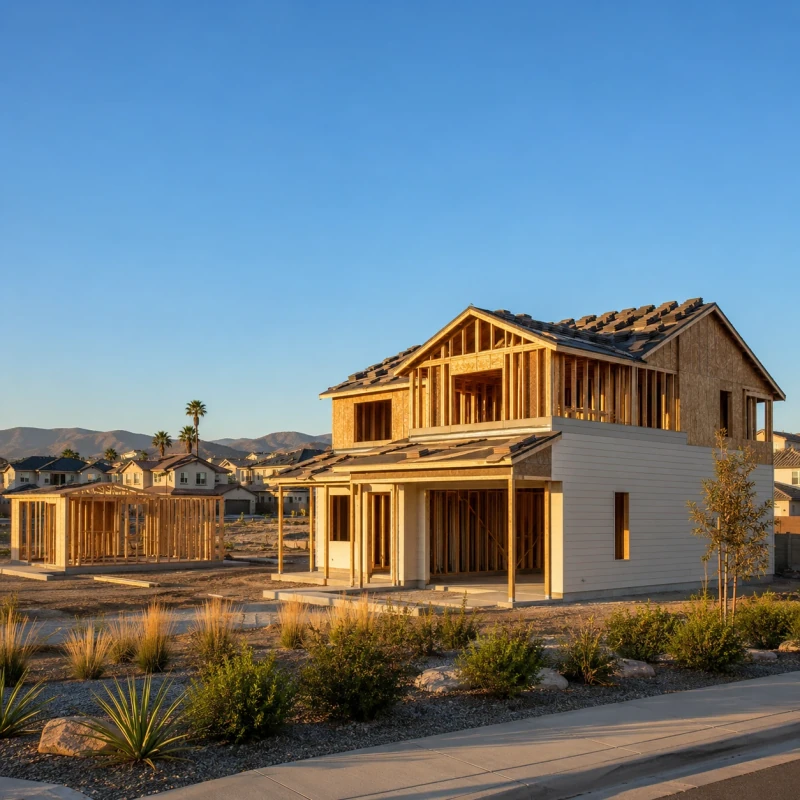
California build-to-rent investors face a financing problem that doesn’t have a clean conventional answer. Construction loans are short-term and require a second closing to convert to permanent financing. DSCR loans cover existing properties, not ground-up builds. Most investors end up running two loans, two closings, and two sets of fees to build and hold a rental property.
DSCR construction loans solve that. The loan funds the build phase with draws as construction progresses, then automatically converts to a 30-year DSCR mortgage at the current market rate when the property is complete. One closing. One loan. Construction plus permanent financing in a single transaction.
The product fits California investors building single-family rentals with ADU income stacks, ground-up duplexes for cash flow, and rehab projects intended to be held as rentals rather than flipped for resale.
- One-time close — construction and permanent financing in a single transaction
- No tax returns or W-2s: qualify on the property’s projected rent
- Loan range $150K to $2M
- Up to 75% LTV at strong credit, scaling with FICO and loan size
- 1.15 DSCR required at conversion to permanent loan
- Single-family + ADU eligible with rental income stacking
- Interest-only payments on drawn portion during construction
- 12, 15, or 18-month construction periods
- Automatic float-down to current market rate at completion
- 10% overrun contingency built into the loan
- 5/5/5 prepayment penalty (5% for 3 years)
Guidelines vary by program and borrower profile. Contact us for current terms.
What Are DSCR Construction Loans in California?
DSCR construction loans finance new construction or substantial rehab of investment property in a single loan that combines a construction phase with a permanent DSCR mortgage. The loan funds the build with scheduled draws, and at completion it converts automatically to a 30-year DSCR loan at the prevailing market rate.
The structure exists because the conventional two-loan path (construction loan plus separate permanent financing) doesn’t work well for build-to-rent investors. A construction loan ends when the property is complete. A new permanent loan requires a second closing, a second appraisal, and a second set of fees. For investors building rentals at scale, that overhead adds up.
A DSCR construction loan eliminates the second closing. The same loan that funded the build becomes the permanent mortgage at completion. The borrower goes from acquisition through perm financing without ever closing twice.
The product is for non-owner-occupied investment property. Primary residence construction uses a different structure. For comparison see our construction-to-permanent loans page.
How a DSCR Construction Loan Works in California
The loan has three phases: closing, construction with draws, and conversion to permanent financing.
Closing combines the construction loan and the permanent loan into a single closing event. The borrower signs one set of loan documents that govern both phases. The initial draw at closing funds land acquisition (if the borrower is buying the lot in the same transaction) or pays off an existing land lien (if the borrower already owns the lot), plus the first phase of construction costs.
Construction phase runs 12, 15, or 18 months depending on project scope. Construction funds release through scheduled draws tied to project milestones. Inspections verify work completion before each draw. The borrower pays interest only on the drawn portion of the loan, not the full loan amount, during this phase.
Conversion to perm happens automatically when construction is complete and the property receives its certificate of occupancy. The loan converts to a 30-year DSCR mortgage at the current market rate. There’s no new closing event, no new appraisal beyond the final inspection, and no requalification.
The 1.15 DSCR ratio gets verified at conversion using the final property’s projected rental income against the converted loan’s debt service.
How You Qualify: Rental Income, Not Tax Returns
Because this is a DSCR loan, qualification runs on the property’s projected rental income, not your personal income. No tax returns, no W-2s, no proof of personal earnings on the borrower side.
Both first-time builders and experienced investors qualify. The product doesn’t require prior construction track record on the borrower side, though experienced investors get better pricing.
The two parties that need to qualify:
- The borrower needs to meet credit, reserve, and down payment requirements (same general framework as standard DSCR, see our DSCR loans page for the credit and qualification details that carry across).
- The builder needs to pass our standard approval process. That’s a 10-to-15-day background check (no credit or financial review on the builder side). Once approved, the builder stays in the system for future projects.
If you’re not sure who you’ll use as a builder, we can start the borrower-side review in parallel with builder approval. Both finish around the same time.
What Are the LTV and Loan Size Tiers?
LTV scales with credit score and loan size. The general framework:
- Strongest credit (740+ FICO) on smaller loans (around $1M) accesses the highest LTV tier, up to 75% on purchase and rate-and-term construction
- Mid-tier credit (720+) typically caps a step lower, 70% across the board at smaller loan sizes
- Lower credit (680 minimum) drops LTV further, with 60% caps becoming common at the upper end of the loan range
- Larger loans (closer to $2M) see LTV step down at each credit tier, since lender risk concentration is higher
Minimum loan amount is $150K. Maximum is $2M. The full grid varies by current program guidelines. We model the specific deal during pre-approval so you know your LTV and rate tier before committing to land or builder selection.
Will your project pencil to a 1.15 DSCR?
Send the land cost, construction budget, and expected rent at completion. We’ll tell you within 24 hours whether the project hits the 1.15 ratio and what terms apply.
Get a free assessment →What Property Types Qualify for DSCR Construction Loans?
DSCR construction loans cover residential investment property:
- Single-family detached rentals are the most common use case
- Single-family with one ADU on the same lot qualifies, and the ADU rental income stacks toward the 1.15 DSCR ratio at conversion (see the ADU stacking discussion on our main DSCR page for the California ADU rules under SB 9 and AB 68)
- 2-4 unit small multifamily new construction qualifies with similar mechanics, though loan amount caps may apply
- Substantial rehab of existing residential property (where the project includes structural work, additions, or major renovations) can use the DSCR construction structure
5+ unit multifamily new construction crosses into commercial-flavored programs. See multifamily loans for that path.
The product is investment-property only. Owner-occupied new builds use a different program.
What Happens When Construction Goes Over Budget?
Every project budget has variance. The loan accounts for it.
A 10% contingency is built into the loan at origination. If construction costs come in within 110% of the original budget, the contingency covers the overrun and the project completes through the same loan.
If costs exceed the 10% contingency, the borrower has two options:
- Refinance the construction loan to bring in additional funds before completion
- Contribute personal capital to close the gap and finish construction within the existing loan
The 10% contingency is a fixed feature of the program, not a per-project negotiation. Building the contingency into upfront budget planning is the practical approach. A $1M build with a $1M loan effectively gets $1.1M of construction capital before requiring outside funds.
How Does the Loan Convert to Permanent DSCR Financing?
The defining feature of the product is the automatic conversion. When construction completes:
- Certificate of occupancy is issued (or the equivalent for the property type)
- Final inspection confirms the property matches the approved plans
- The 1.15 DSCR ratio is verified using the final property’s projected rental income against the converted loan’s debt service at the current market rate
- The loan converts to a 30-year DSCR mortgage at the prevailing rate at conversion
The “float-down” terminology refers to the rate the borrower locks for the permanent phase. The construction phase has its own rate (typically higher and interest-only). At conversion, the loan picks up the current market DSCR rate, which is usually meaningfully lower than the construction rate. The borrower doesn’t have to apply for the rate, qualify again, or close a new transaction. It’s the same loan that funded the build.
If market rates move lower during construction, the borrower benefits. If rates move higher, the conversion still happens at the prevailing rate (there’s no rate guarantee through construction). Either way, the conversion is automatic and built into the original loan documents.
Fix-and-Hold vs Fix-and-Flip: Which Path Fits Your Strategy?
The two strategies use different products even when the underlying property looks similar:
- Fix-and-hold uses a DSCR construction loan. You acquire and build (or rehab), then hold the property as a rental. The DSCR construction loan converts to a 30-year DSCR perm at completion. Exit through long-term cash flow, not sale.
- Fix-and-flip uses a fix and flip loan. You acquire and renovate within a short window (6-18 months), then sell at completion. Exit through the sale, not through holding.
The financing structure follows the exit strategy. A property you plan to hold as a rental should be financed as such from acquisition forward. A property you plan to sell at completion uses a short-term loan structured for that timeline. Picking the wrong product wastes money in either direction.
If you’re not sure which path fits your project, the question to answer first is what happens at month 18: sale or rent. That answer drives the loan choice.
DSCR Construction vs Traditional Construction-to-Permanent
The two products both finance new construction with a perm phase at the end, but they target different borrowers:
- Traditional construction-to-permanent typically qualifies the borrower on personal income, with the permanent phase structured as a conventional mortgage. It’s the standard path for owner-occupied new construction.
- DSCR construction qualifies on property rental income rather than borrower income, with the permanent phase being a DSCR loan. It’s the investor-focused version of the same mechanic.
A borrower who plans to live in the completed property uses traditional construction-to-perm. A borrower who plans to rent the completed property uses DSCR construction. The mechanic is similar but the underwriting is fundamentally different.
For investor borrowers who can’t or don’t want to qualify on personal income (self-employed, retired, foreign national, real estate professional), DSCR construction is generally the cleaner path even if traditional construction-to-perm is theoretically available.
Where Are DSCR Construction Loans Available in California?
Statewide. The product is available across all 58 California counties. No specific city or region restrictions apply.
That said, build-to-rent economics work better in some California markets than others. Properties in the Central Valley and Inland Empire (Riverside, San Bernardino, Fresno, Bakersfield, Sacramento metro) typically pencil cleanly on the 1.15 DSCR ratio because land acquisition and construction costs are lower while rental demand remains strong. Bay Area and Southern California coastal markets require larger investments and tighter underwriting to hit the same ratio.
The program doesn’t differentiate by geography in its terms. Land cost, build cost, and projected rental income at completion are the variables that matter. We model the specific project before pre-approval so you know whether it pencils before committing land.
What Are DSCR Construction Loan Rates and Costs?
Rates vary with credit score, loan size, LTV, and current market conditions. Rather than quote rates that change weekly, we price specific projects against your actual deal parameters.
Two rate components matter:
- Construction phase rate is typically higher than perm and applies to drawn funds only. Interest-only payments during construction.
- Permanent phase rate is the DSCR rate that takes effect at conversion. Whatever the market is offering for 30-year DSCR loans at the conversion date.
Everyone’s situation is different. Quoted rates aren’t guaranteed. We’ll model your specific deal with current market data when you’re ready to move.
Get a real rate quote
Free consultation. No pressure, no fine print. We answer the phone.
What Prepayment Penalty Applies to DSCR Construction Loans?
A 5/5/5 prepayment penalty applies, meaning 5% of the loan balance if the loan pays off within the first three years after conversion to perm.
The prepay structure is a feature of the asset class. DSCR lenders price loans based on a holding period assumption, and the 5/5/5 structure compensates for early payoff. For investors planning to hold the property as a long-term rental, the prepay window is irrelevant. For investors who might refinance or sell within three years of conversion, the penalty needs to be in the financial model from day one.
The penalty applies to the permanent phase, not the construction phase. Paying off the loan during construction (through refinance into a different product, for example) carries different mechanics.
Should You Get a DSCR Construction Loan in California?
The product fits a specific use case: building or substantially rehabbing a residential investment property that you plan to hold as a rental rather than sell at completion. If that describes your project, the one-time-close structure saves a closing, a set of fees, and significant transaction overhead compared to the two-loan path.
Every project is different, and the most useful step is modeling the specific deal (land cost, build cost, projected rental income at completion, and credit tier) to confirm the project pencils to a 1.15 DSCR. We’ll review your numbers and tell you whether the project qualifies and what terms apply.
Call (442) 245-5626 to discuss your build-to-rent project or view all construction and renovation programs.
Begin your application → or schedule a call to discuss your project.
Explore Related Investment Property Financing
Not sure if DSCR construction is the right fit? Compare our other investment property financing options including DSCR loans for existing rental property purchase, fix and flip loans for short-term renovation projects, multifamily loans for 5+ unit properties, and LLC funding programs for entity-owned investment property.